Gaps in data deletion verification and auditability
All systems reported “Deletion succeeded” after Kathy submitted a data deletion request on the company website last month. Yet she is still receiving personalized marketing emails, internal services are still passing around her data, and her order history still appears in business analytics reports.
Something has clearly gone wrong.
A deletion request is often treated as complete once a workflow reports success, but that signal doesn’t mean data has been removed from all infrastructure or excluded from all processing activities.
Most systems can confirm they executed a deletion request. Very few can confirm whether all personal data associated with a customer was actually removed everywhere it existed and remained absent over time.
That gap between “operation completed” and “data is fully removed from processing” is where most deletion guarantees fail in practice.
What was tracked as success
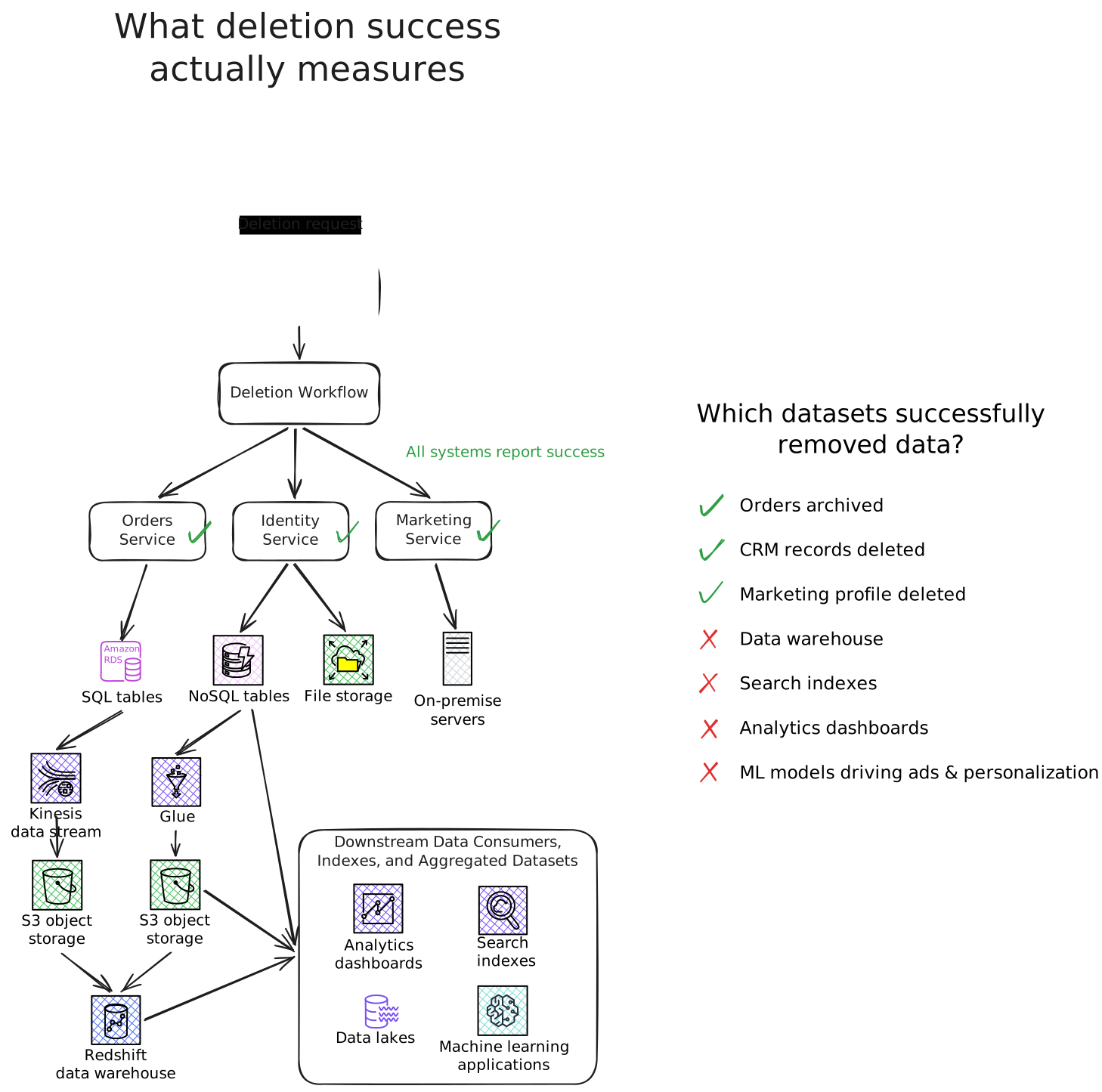
In distributed systems, a deletion request typically passes through an orchestrated workflow:
- a central service receives the request
- tasks are fanned out to onboarded backend systems
- each system executes local deletion logic
- success/failure signals are reported back to the orchestrator
At the end of this flow, the system reports success, but with a narrow interpretation:
- the request was accepted
- all tasks were executed or acknowledged
- no immediate errors were returned
This doesn’t mean that the customer’s data has been removed from processing across all systems.
Deletion is treated as an operation, not a system-wide, verifiable state.
An idealized system model
A fully verifiable deletion program would require:
- A complete and continuously updated inventory of systems storing or processing personal data
- Lifecycle state of each system’s deletion capabilities and onboarding status
- End-to-end visibility into deletion requests across all systems
- Backfill of prior deletion requests for onboarded systems
- System-wide prevention of reintroduction of deleted identities
Why this model does not exist in practice
Each component is reasonable in isolation, and many organizations already have partial implementations: system catalogs, deletion workflows, onboarding processes, and audit logs. However, end-to-end provability remains unsolved, with structural gaps in environments where infrastructure is continuously evolving.
1. System inventories drift from reality
System inventories are frequently incomplete and not automatically maintained, especially those specific to privacy expectations. New services appear without formal registration with privacy workflows, new data flows emerge through API integrations and ad-hoc data pipelines, and third-party integrations bypass internal catalogs.
As a result, system coverage both lags reality and becomes stale even for existing services. Teams may accurately attest to their current state and start processing new types of customer data tomorrow.
2. Deletion capabilities are inconsistently deployed
Deletion support is typically added incrementally across services, often focused on primary data storage while excluding derived datasets and downstream data pipelines.
This creates a persistent mismatch between documented and actual enforcement.
3. Deletion state is local, not system-wide
Even where deletion workflows exist, state is local. A system can confirm it executed a deletion request, but has no visibility into whether upstream and downstream systems have done the same.
This is a direct architectural outcome of how distributed systems are designed for local correctness and independent development.
4. Deletion history is fragmented
Backfilling prior deletion requests after onboarding assumes a replayable deletion request record and a complete history of request fulfillment across systems.
Without this history, newly onboarded systems may have no reliable mechanism to identify customers whose data should already have been deleted.
The deletion request record is often easier to centralize than fulfillment evidence, which is often fragmented across systems due to inconsistent logging, deletion semantics, and retention policies.
5. Deletion does not prevent future processing
Preventing reintroduction of deleted data is not centrally enforceable. It must hold across all platforms, pipelines, warehouses, event systems, and API integrations, each with different semantics for processing personal data.
A customer deleted today can reappear tomorrow through historical imports, replicated datasets, replayed event streams, or integration with systems not onboarded to deletion.
Typical verification approaches
- Sampling-based checks
- Per-system logs that may differ in format, granularity, and completeness
- Best-effort reconciliation reports
- Manual audits during compliance review
None provide systemic guarantees. More fundamentally, proving the absence of data is often harder than proving that a deletion workflow executed successfully.
As a result, organizations often rely on process evidence rather than proof of outcome. Auditors and regulators may be shown that deletion workflows executed successfully, even when there is limited visibility into whether personal data was removed from all systems that process it.
When a customer finds evidence that their data was not actually deleted, this can trigger regulatory scrutiny, corrective actions, and potentially significant financial penalties.
Toward a real verification model
Automated inventories and compliance tracking
We need continuous discovery of systems and datasets containing personal data, and unified deletion state tracking. This is an incremental process that may initially only cover a few technologies where automation is easiest.
Many organizations may rely on periodic manual processes where service owners attest to new personal data processing use cases and follow guidance on privacy expectations.
Lowering compliance effort through automation and tooling
Compliance outcomes improve when we have automatic tracking and accountability for deletion expectations, and low-effort mechanisms for onboarding datasets to service-appropriate deletion mechanisms.
This is not one-size-fits-all, as each system may have different deletion semantics, such as hard deletion, retention but suppression from downstream processing, scheduled archival and eventual deletion, or anonymization.
Organizations can achieve more consistent deletion outcomes when reusable tooling and patterns exist for common deletion strategies.
Standardizing proof of deletion
Global deletion state requires thorough, continuous detection and tracking of all datasets that store personal data, and per-system-and-request deletion statuses.
Verification also requires clearly defined deletion semantics for each system, since the expected outcome may be hard deletion, anonymization, suppression from downstream processing, or retention under a legal exception.
Standardized traceability of per-system request fulfillment and deletion semantics provides a stronger foundation for demonstrating deletion outcomes.
Enforcing exclusion of data from processing
There is no simple, universal solution to enforce that data subject to deletion is never processed outside of legally permitted exceptions.
However, we can get closer to the expected state when all systems that store personal data subscribe to and backfill deletion requests, and when systems that retain personal data that is subject to deletion implement access controls to suppress use by downstream services.
Closing thoughts
Privacy tooling often focuses on answering where personal data lives, and whether a deletion request was executed across the owning services. A larger challenge is determining whether personal data remains absent from all systems where it should no longer be processed.
As architectures evolve, new systems, integrations, and data flows continually expand the scope of deletion obligations. Verification must therefore be continuous rather than point-in-time.
Without system-wide visibility into deletion state and enforcement outcomes, organizations are left validating workflow execution rather than deletion itself, leaving them unable to determine whether customers like Kathy are still being processed.
Posts in this series
- Why data deletion is still an unsolved infrastructure problem
- Why deletion means different things in different systems
- (Current post) Gaps in data deletion verification and auditability
- Deletion is not always deletion: retention exceptions and competing obligations
- Deleted and back again: mitigating unintended data resurrection
- Model a deletion graph, but don’t execute it