Why data deletion is still an unsolved infrastructure problem
A customer submits a data deletion request that propagates across backend services. One service only partially deletes the customer’s records due to a bug. Another misses the request because it was down for maintenance, and several analytics datasets were never integrated into the deletion process.
Months later, the customer continues receiving highly personalized marketing emails from the company. She submits a data access request and discovers that the company still has her name, address, phone number, purchase history, and detailed behavioral data from years of interactions with their services.
What began as a routine privacy request has now become a regulatory problem. A complaint to a data protection authority leads to an investigation, revealing an inability to demonstrate consistent deletion across the company’s systems. The company now faces corrective action and potential penalties.
Many of these failures were invisible to the company until the compliance team had to prove that deletion had actually occurred everywhere.
A typical deletion request path
A single request initiated from a customer-facing application may propagate across multiple services, storage systems, analytical platforms, and downstream consumers. Each system may implement deletion differently, operate on different schedules, or fail independently.
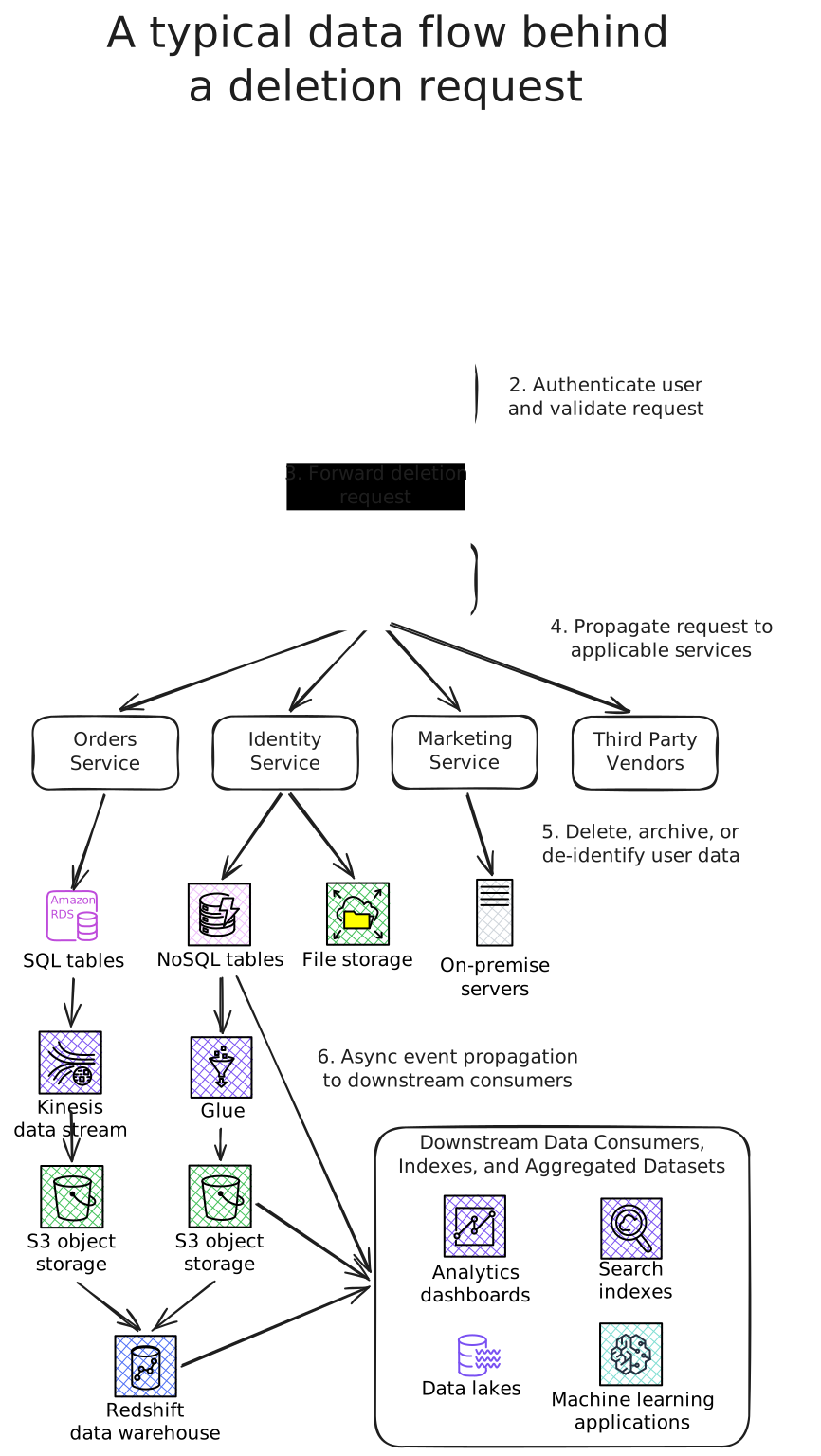
No single team owns the entire lifecycle. Application teams own services, platform teams operate infrastructure, analytics teams maintain data pipelines and data warehouses, and additional systems produce or consume derived datasets.
The problem becomes significantly harder at enterprise scale. Large organizations may operate hundreds of independently managed services and thousands of datasets while continuously adding new data flows and third-party integrations.
Over time, data lineage becomes more difficult to track, inventories become harder to maintain, and deletion workflows diverge across teams. What begins as a straightforward compliance requirement gradually becomes a coordination problem spanning large portions of an organization’s infrastructure.
The hidden complexity behind a “simple” deletion request
From a user’s perspective, deleting personal data sounds simple.
Inside a modern organization, the same request can require teams to:
- Locate all systems containing relevant customer data
- Resolve identifiers across different schemas and services
- Execute system-specific deletion logic
- Verify completion across distributed components
- Handle retries and partial failures
- Produce audit evidence
- Prevent downstream recreation of deleted data
Customer data rarely exists in a single form. The same individual may appear as a primary key in a transactional database, an attribute in an analytics platform, or within large object-store datasets shared across many users. Deletion often requires system-specific logic tailored to how each platform stores and processes data.
The core difficulty is coordinating consistent execution across systems with different deletion semantics, retention policies, operational constraints, and failure modes.
The execution gap in privacy tooling
The privacy technology ecosystem has matured significantly. Organizations now have access to tools for privacy request management, governance, and data discovery.
These tools address important parts of the problem, but they do not solve execution.
Governance platforms help define what should happen. Cloud-native capabilities help execute deletion within individual systems. Between those layers is the challenge of executing and validating deletion across production systems.
Organizations often fill this gap with scripts, service-specific workflows, and operational procedures that become increasingly difficult to maintain, validate, and audit as independently managed services proliferate and coordination requirements compound across teams.
Why right-to-erasure is uniquely challenging
Among privacy requirements, right-to-erasure (“the right to be forgotten”) places some of the greatest demands on an organization’s architecture.
Unlike many privacy obligations, deletion cannot be satisfied through policy alone. Organizations must coordinate actions across all systems where customer data resides and demonstrate that those actions completed as intended.
This exposes architectural inconsistencies that might otherwise be missed:
- Systems that interpret deletion differently
- Incomplete or unverifiable audit trails
- Service-specific workflows that are difficult to maintain
- Fragile operational dependencies
- Manual processes that don’t scale
Right-to-erasure is therefore more than a privacy requirement. It is a stress test of an organization’s ability to manage data consistently across its infrastructure.
Privacy as an architectural capability
The industry has largely approached privacy as a governance problem.
However, governance alone does not execute deletion, validate outcomes, recover from failures, or provide consistent guarantees across distributed systems.
Privacy obligations increasingly depend on infrastructure capabilities that most organizations were not built with.
That means treating privacy as a first-class architectural concern rather than a collection of scripts and workflows. Organizations need a way to define, execute, and verify deletion consistently across systems.
What comes next
If deletion is fundamentally an infrastructure problem, the next step is understanding how and why it fails in practice at scale.
In upcoming posts, we’ll explore common failure modes in deletion programs, including inconsistent deletion semantics, coverage gaps as architectures evolve, resurrection of previously deleted data, and gaps in verification and auditability.
After that, we’ll examine the structural properties of deletion programs that allow organizations to consistently orchestrate, execute, and verify deletion across distributed systems.
Posts in this series
- (Current post) Why data deletion is still an unsolved infrastructure problem
- Why deletion means different things in different systems
- Gaps in data deletion verification and auditability
- Deletion is not always deletion: retention exceptions and competing obligations
- Deleted and back again: mitigating unintended data resurrection
- Model a deletion graph, but don’t execute it