Deleted and back again: mitigating unintended data resurrection
Kathy submits a personal data deletion request. Ordering, marketing, and personalization systems remove her records, and yet, a week later, her data is back as if nothing had happened.
In complex data architectures, keeping deleted personal data deleted is a persistent engineering challenge. Systems re-ingest, recompute, replay, and repopulate data long after a deletion request has been processed.
A single missed dataset can re-propagate a user’s personal data across an organization’s interconnected systems, undermining the best attempts at achieving deletion.
What is data resurrection?
Data resurrection is the unintended reintroduction of personal data into a system after that data has been deleted or should no longer be processed.
This is distinct from:
- Re-identification, where anonymized data becomes identifiable through inference or aggregation.
- Retention exceptions, where data is intentionally preserved for legal or operational reasons.
Common sources of unintended data resurrection
Source 1: Upstream systems not onboarded to deletion
Upstream systems that still hold personal data continue emitting events, syncing records, or serving APIs that downstream systems consume. Even if downstream systems correctly delete a customer’s personal data upon request, they will re-ingest whatever their upstream dependencies continue to publish.
Source 2: Out-of-order deletion
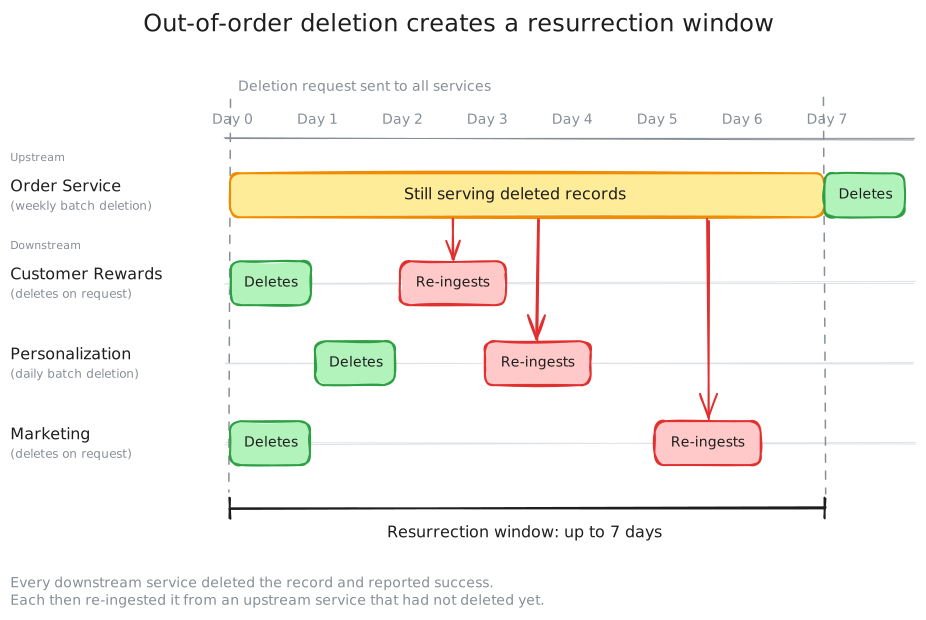
Many deletion workflows have a hidden assumption that upstream systems delete first and downstream systems follow. When this ordering isn’t enforced, downstream systems delete and re-ingest a customer’s personal data from upstream systems that haven’t deleted yet.
Even if deletion requests are sent to upstream systems first, workflows are often asynchronous. Some services delete immediately, while others batch deletions into daily or weekly jobs during periods of low customer traffic.
Source 3: Soft deletion across system boundaries
When an upstream system soft-deletes a record by setting a “deleted” flag and continues propagating it, the record carries its deletion state in a field that downstream consumers must be aware of. Consumers may not act on that flag, especially if it was added after the integration was built. The result is that soft-deleted records can still be treated as active downstream.
Source 4: Event replay and cached data
Systems that replay events, cache data, or ingest historical data snapshots from upstream services can inadvertently maintain or reintroduce personal data that was deleted from primary data stores.
Replay and sync workflows need to propagate deletion markers or tombstones. Caches and search indexes also need an explicit deletion path.
Source 5: Restored backups
Disaster recovery workflows restore data from backups that predate the deletion request. Unless backup recovery and data sharing workflows are deletion-aware, restoring a single upstream backup can repopulate dozens of downstream systems with previously deleted personal data.
Organizations often do not remove customer data from backups, but recovery processes must account for deletion requests since the backup was taken. Centralized resurrection detection and re-deletion workflows can reduce service-specific recovery logic, at the cost of temporarily propagating resurrected data before it’s caught.
Source 6: Silent deletion failures
When systems report “success” after receiving or processing a deletion request but silently fail to delete or anonymize all records, they can continue to be sources of unredacted personal data long after a deletion request.
Silent failures can stem from schema drift or deletion logic that does not cover all secondary or derived datasets.
Controls to mitigate data resurrection
It’s tempting to say that every system should simply implement deletion and that orchestrators should enforce a global deletion order across the dependency graph.
In practice, this is not feasible in large organizations. You cannot guarantee deletion order across a large number of systems with different semantics, asynchronous workflows, independent scheduling, bidirectional data flows, and varied failure modes.
The practical goal is not perfect ordering of deletion. It is eventual deletion: every system should converge to its expected deletion state within the applicable deletion window, and the organization should detect those that do not.
Control 1: Automatic detection and deletion replay
Periodic checks for deleted identifiers can help find data that was missed or later introduced, and trigger a notification to onboard to deletion workflows or replay deletion if the service was already onboarded.
However, replaying deletion requests isn’t a silver bullet. Continually polling for re-emergence of deleted data and retriggering deletion requests creates churn, increased service load, and does not scale with high numbers of accumulated deletion requests. When the underlying resurrection pathways remain open, deletion replays simply repeat the same work indefinitely.
Control 2: Deletion-aware access controls
Deletion-aware access controls prevent services from accessing or propagating data for customers whose data has been deleted. A platform team should build these once for reuse, rather than each service implementing its own.
The simplest implementation is a query layer that checks a central deletion registry before returning a record, so that data subject to deletion is blocked from processing. Where low latency is critical, services can maintain a locally replicated set of deleted identifiers with a defined maximum delay between a deletion decision and its availability to the service. The tradeoff is between enforcement latency and query-time overhead.
These controls create deletion boundaries. Even if some upstream systems have not yet onboarded to deletion, data propagation stops at the boundary of any system that enforces deletion-aware access controls.
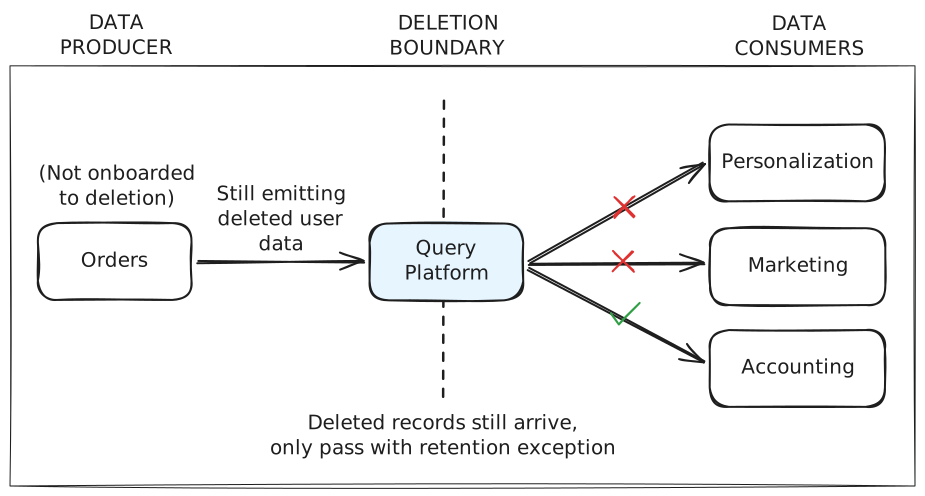
Deletion-aware controls do not eliminate the need for deletion replay, since data can still reach systems that do not enforce these controls before it reaches a deletion boundary. Those systems remain in scope for detection and remediation, but the boundary limits how far the resurrected data can propagate.
Control 3: Automatic expiry of data
Some systems only need recent data to operate. These can automatically delete records after a defined time period shorter than the applicable deletion window, using time-to-live (TTL) or object expiry lifecycles.
These services may not need explicit deletion onboarding if they can demonstrate that data is automatically removed within the deletion window.
Control 4: Data minimization
Where possible, the simplest option is often to stop processing personal data in the first place.
Given the choice to invest weeks of effort on deletion workflows, or spend a day dropping fields and stale datasets that are no longer needed, many teams may pick the latter, reducing compliance risk and storage costs in the process.
A deletion resilience maturity model
The following maturity model is a conceptual framework for thinking about deletion resilience. Levels are defined by who owns deletion logic, and how effectively resurrection is caught and mitigated.
| Level | How deletion is implemented | What resurrection looks like |
|---|---|---|
| 1. Service-owned | Each system builds its own deletion logic, often inconsistently. Service owners self-identify when they need to onboard. | Common, and usually undetected. Upstream systems may not delete, downstream systems re-ingest. Deletion replays and manual clean-up are frequent and expensive, or the risk is accepted. |
| 2. Platform-assisted | Deletion is treated as privacy infrastructure rather than a cost each service absorbs. Shared tooling offers hard deletion, TTL expiry, and deletion-aware access controls with common semantics. | Still occurs, but contained and easier to remediate. Deletion replays run periodically across services where resurrection is detected. |
| 3. Systemically resilient | Controls are built into infrastructure by default, with centralized deletion state, deletion-aware boundaries, and minimal service team context needed to implement or validate. | Rare, localized, and quickly corrected. Automated detection and reconciliation cover replay and recovery paths. |
Many organizations can have characteristics of both Levels 1 and 2: tooling may exist, while onboarding costs enough that a long tail never fully completes it, leaving resurrection a systemic risk. Moving from Level 1 to Level 2 is mostly a tooling problem. Level 3 requires deletion state to be treated as an organization-level architectural concern rather than solely as service-local logic.
Deletion resilience is a systems property, not a per-service outcome
A successful deletion response does not prove that personal data has stopped being processed across systems with deletion expectations.
Organizations need to understand how personal data subject to deletion can continue to propagate. They should enforce containment controls in systems with legitimate retention exceptions, and build verification mechanisms that test both successful deletion and reintroduction of previously deleted data.
Evidence should show which systems are subject to deletion, which have compensating measures such as automatic expiry, and which retain data under approved exceptions. Retained data should be blocked from use for unapproved purposes.
Deletion resilience is not achieved by making every system delete perfectly or by enforcing a single global deletion order.
It comes from making deletion state durable, containing deleted data at system boundaries, allowing deletion state to converge within the applicable window, and continuously detecting and correcting resurrection.
Posts in this series
- Why data deletion is still an unsolved infrastructure problem
- Why deletion means different things in different systems
- Gaps in data deletion verification and auditability
- Deletion is not always deletion: retention exceptions and competing obligations
- (Current post) Deleted and back again: mitigating unintended data resurrection
- Model a deletion graph, but don’t execute it